21 Tools for Thriving with AI
However artificial intelligence is a part of your life, the 21 tools in "AI and the Art of Being Human" provide an essential framework for human-centric decisions
[Image]
This post provides a concept overview of the core framework in AI and the Art of Being Human — the 21 tools designed to help people and organizations thrive with AI while deepening their understanding of what it means to be human in an age of artificial intelligence. Unlike many AI books that focus on technical capability or future speculation, AI and the Art of Being Human centers on human agency, meaning, and care in the present.
I’ve already written about the thinking and purpose behind AI and the Art of Being Human by Jeff Abbott and myself. But I haven’t said much yet about the core of the book: the 21 tools designed to provide a practical guide to thriving in an age of AI.
These tools were designed to form the backbone of a business management guide or course text that provides a concrete framework for navigating a world that’s increasingly dominated by AI.
But, and as readers are discovering, they they were also very intentionally designed to be practically useful to anyone who’s navigating the line in their personal and professional lives between AI fears, concerns, possibilities, and hopes — and how to retain human agency wile using AI.
This applies as much to organizations developing and deploying the latest iterations of agentic AI as it does to parents, students and others grappling with the current wave of generative AI apps.
What this book teaches about being human in an age of AI
In the book we present the 21 tools for enabling human agency with AI through four progressive sections.
In Part I—Mindsets for an Age of AI—we introduce the Mirror Test, the Curiosity Loop, the Intent Map, the Human Qualities Spectrum, the 4-Lens Scan, and the 7-Minute Clarity Pause.
Part II moves on to focus on navigating change. Here, we introduce a series of tools that provide practical guidance for keeping humans at the center of things as AI systems become increasingly ubiquitous in our lives. These include the Identity Matrix, the STARS Framework, the Stress-Test Table, and the Micro-Circle Launch Kit.
In Part III we turn the focus from individuals navigating AI, to thriving in partnership in a world of artificial intelligence and putting human-centric AI at the center of things. Here, the tools include the Orchestration Triangle, the CARE Loop, The Model Dignity Check, the Prompt-Scaffold Canvas, and the Multimodal Ideation Sprint.
Finally, Part IV looks to building intentional futures together. It kicks off with the Roadmap Canvas and moves on to the Community Flywheel, the Starter Charter, the Pocket Card, the One-Line Vow, and the Commitment Ladder.
Full details of all of these tools—including how to use them— are (obviously) available in the book. And summaries are also available on the book’s website at aiandtheartofbeinghuman.com.
Its worth checking both of these resources out. But to give you a quick sense of the tools, here are four examples:
Four tools for being human in an age of AI
Using AI: The Intent Map
[Image]
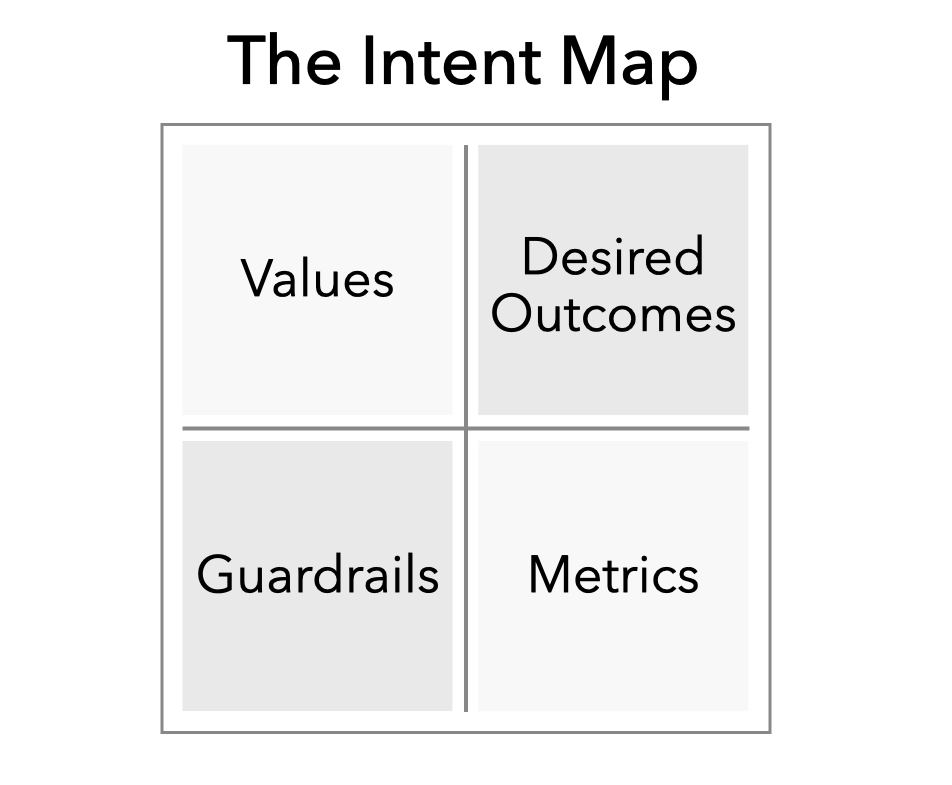
What it is: A simple visual tool that makes your values visible before momentum or pressure takes decisions away from you.
Where you would use it:
Before implementing any AI system in your organization
When speed and ethics seem to conflict
When you need to clarify what matters most in a project
When your team needs alignment on non-negotiables
The tool: Four Quadrants (draw a simple grid):
Values (upper left): What you refuse to compromise, no matter the pressure
Desired Outcomes (upper right): The specific, concrete outcomes or changes you’re seeking
Guardrails (lower left): Hard boundaries—what you absolutely won’t do
Metrics (lower right): How you’ll measure what actually matters, not only what’s easy to count
How to use it: Draw a simple grid—this could be on a napkin. Fill each quadrant in order, spending no more than an hour on your first version.
Start with Values (your non-negotiables), then Outcomes (what specific change you want), then Guardrails (your “never do this” boundaries), finally Metrics (measuring meaning, not just numbers). The magic is in how they connect: values without metrics are just words; metrics without values optimize for the wrong things. Review monthly and adjust based on what you’re learning.
Uniquely Human: The Human Qualities Spectrum
[Image]
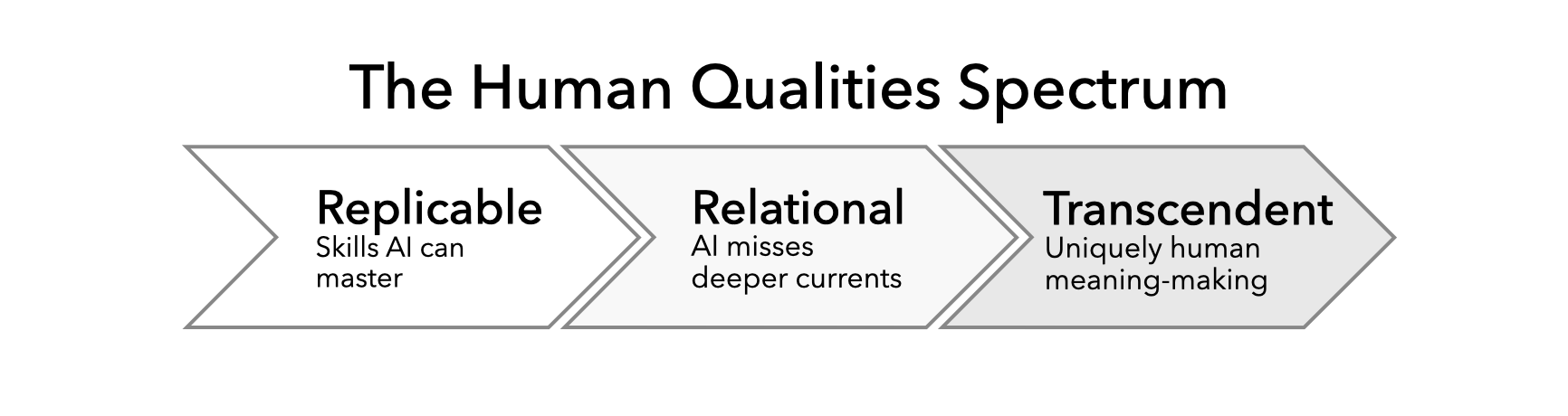
What it is: A way to understand which human qualities AI can replicate and which remain uniquely ours—not to compete, but to focus on what matters.
Where you would use it:
When AI matches or exceeds your professional capabilities
When questioning your value as machines improve
When deciding where to invest your development energy
When feeling threatened by AI replicating your style or skills
The tool: A Spectrum flowing left to right:
Replicable (left): Skills AI can master—calculation, pattern recognition, and even certain creativity. Most “knowledge work” lives here
Relational (middle): Human presence and context—emotional attunement, reading the room, navigating unique moments. AI participates but misses deeper currents.
Transcendent (right): What emerges from being human—meaning-making, moral imagination, choosing to find sacred what others call ordinary. These arise from having something at stake.
How to use it: List 10 activities that define your work or identity. Place each somewhere on the spectrum from Replicable to Transcendent. Be honest—many skills you’re proud of may fall toward the Replicable end, and that’s okay. The insight comes from seeing where you cluster: are you investing primarily in the left side where AI will eventually excel? Shift your focus toward developing qualities further to the right on the spectrum—not to be special, but to be fully human. Remember: this isn’t a hierarchy; we need all parts of the spectrum, but must stop pretending the left side makes us irreplaceable.
Human-Centered AI: The CARE Loop
[Image]

What it is: A team practice that scales individual clarity into organizational compassion and systematic care.
Where you would use it:
When your team needs to embed care and dignity into AI systems and their use
When implementing AI that affects employees, customers, or other stakeholders
When organizational speed conflicts with human care
When you need to build care into company culture, not just compliance
The tool: Four Movements for teams:
Context: Map the whole system—who’s affected, what assumptions exist, how different worlds collide in one space
Acknowledge: Name impacts honestly in team settings—make the invisible visible to everyone, not just leadership
Respond: Act at two scales—immediate adjustments in the present, systemic changes in the near future
Evaluate: Review patterns using both metrics and stories—schedule regular “Reflection Hours” to ask what’s working
How to use it: Make this a weekly team practice. Pick one AI process affecting people. Spend 30 minutes running the complete loop together. Document what you discover. Implement at least one immediate fix and identify one systemic change.
Pulling it All Together: The Roadmap Canvas
What it is: A living document that transforms AI understanding into concrete action through 90-day learning cycles.
Where you would use it:
When ready to move from learning about AI to actively shaping your relationship with it
When inspiration needs to become implementation
When you have clarity but lack structure for action
When previous AI initiatives have stalled
The tool: Five Elements (evolves with practice):
[Image]
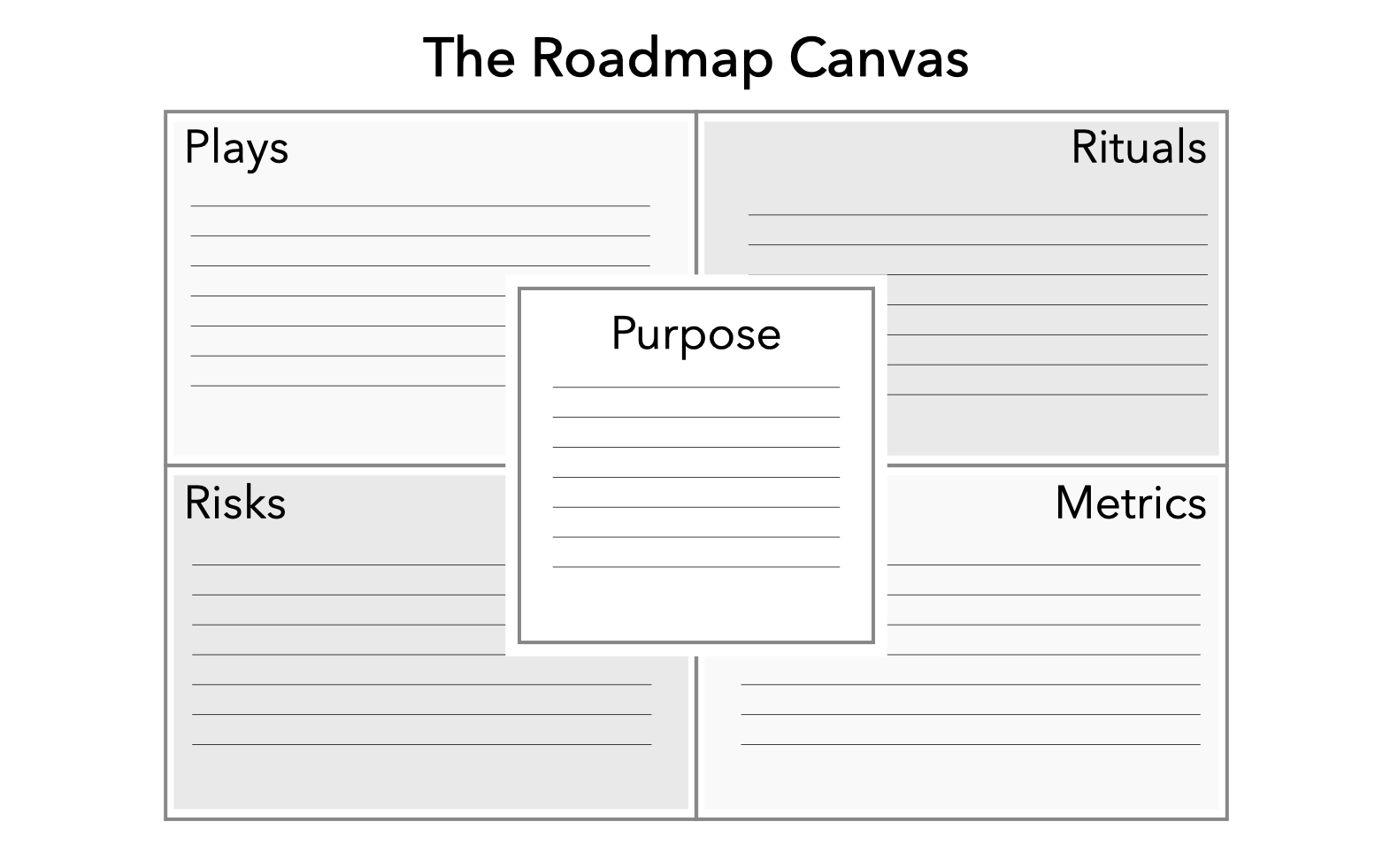
Purpose: Why this transformation matters—not what you’ll build but the more profound change you seek
Plays: Three concrete 90-day experiments—hypotheses to test, not commitments to defend
Risks: Honest assessment via the 4-Lens Scan—what could go wrong, who might be harmed
Rituals: Practices that keep you grounded—not productivity hacks but anchors to purpose
Metrics: Measuring meaning, not just numbers—include stories, energy levels, what actually matters
How to use it: Draft version 1.0 in 30 minutes—it’s meant to be wrong. Review in 30 days, and update based on reality, not projection. Run 90-day cycles: Weeks 1–2 fill out the canvas; Weeks 3–11 run experiments; Week 12 retrospective; Week 13 reframe. Share with an accountability partner who will ask hard questions. The roadmap that changes your life is the one you actually start, not the one you perfect.
All 21 tools are available in AI and the Art of being Human by Jeffrey Abbott and Andrew Maynard, and available most places you get your books. More information can also be found at aiandtheartofbeinghuman.com
[Image]